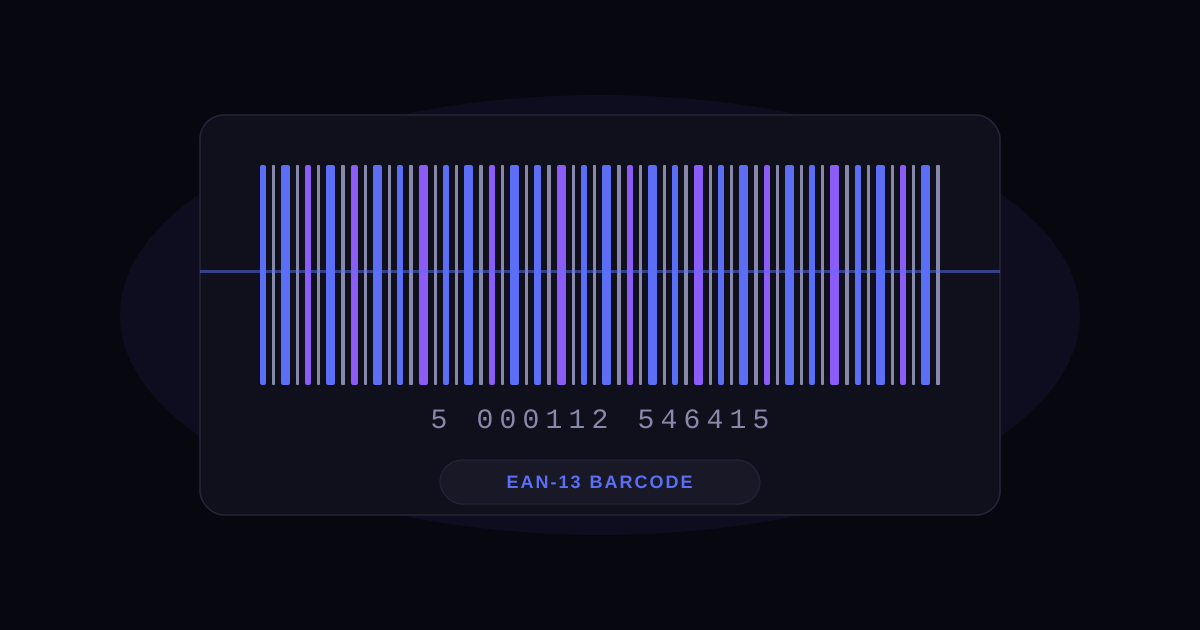
Every product you buy has a barcode on it. But have you ever stopped to wonder what those black and white lines actually mean? Barcodes are one of the most clever inventions in retail history — a simple visual code that contains a product's entire identity. In this guide, we explain exactly how barcodes work, what each number means, and how you can use them to look up any product in the world.
What is a Barcode?
A barcode is a machine-readable representation of data. It encodes numbers and letters as a series of parallel lines (bars) and spaces of varying widths. A barcode scanner reads the reflected light pattern to decode the information — typically a product identification number.
Barcodes were first used commercially in 1974 when a pack of Wrigley's chewing gum was scanned at a supermarket in Ohio. Today, over 5 billion barcodes are scanned every single day worldwide.
"Barcodes are scanned more than 5 billion times per day globally — making them one of the most-used technologies on the planet."
The Main Types of Barcodes
There are dozens of barcode formats, but these are the ones you will encounter most often on everyday products:
| Format | Digits | Where Used |
|---|---|---|
| EAN-13 | 13 digits | Most products worldwide (Europe, Asia, Middle East) |
| UPC-A | 12 digits | North America (USA and Canada) |
| EAN-8 | 8 digits | Small products (lipstick, batteries) |
| ISBN | 13 digits | Books |
| QR Code | Variable | Marketing, menus, payments |
| Code 128 | Variable | Shipping and logistics |
How to Read an EAN-13 Barcode
The EAN-13 (European Article Number) is the most common barcode in the world. You will find it on virtually every product sold outside North America — and increasingly on US products too. It consists of 13 digits with a specific structure:
The 3 Parts of an EAN-13 Number
- Country prefix (first 2-3 digits): Identifies the GS1 organisation that assigned the barcode. For example, 00-09 = USA, 30-37 = France, 40-44 = Germany, 50 = UK, 60-69 = China, 60-74 = UAE and Middle East.
- Company number (middle digits): Uniquely identifies the manufacturer or brand. The length varies — shorter company numbers mean more product numbers available.
- Product number (next digits): Identifies the specific product and variant (size, colour, flavour).
- Check digit (last digit): A mathematical verification digit used to confirm the barcode was scanned correctly.
How to Read a UPC-A Barcode
The UPC-A (Universal Product Code) is the North American equivalent of EAN-13. It has 12 digits instead of 13. In fact, a UPC-A barcode is identical to an EAN-13 barcode with a leading zero added. This means UPC-A barcodes are a subset of EAN-13.
- Number system digit (1 digit): Indicates the product category (0 = regular products, 2 = random weight items, 3 = pharmaceuticals, 5 = coupons)
- Manufacturer code (5 digits): Identifies the brand
- Product code (5 digits): Identifies the specific item
- Check digit (1 digit): Verification
What is the Check Digit and How is it Calculated?
The check digit is a clever mathematical safeguard that ensures a barcode was scanned correctly. Here is how it works for EAN-13:
- Take the first 12 digits of the barcode
- Add together all digits in odd positions (1st, 3rd, 5th... )
- Add together all digits in even positions (2nd, 4th, 6th...) and multiply by 3
- Add both results together
- The check digit is the number needed to make the total a multiple of 10
If a scanner reads a barcode and the check digit does not match, the scan is rejected and the cashier must try again.
Country Codes: Where is This Product From?
The first 2-3 digits of an EAN-13 barcode tell you which GS1 member organisation issued the barcode — not necessarily where the product was manufactured. Here are the most common prefixes:
| Prefix | Country/Region |
|---|---|
| 00–09 | United States and Canada |
| 30–37 | France |
| 40–44 | Germany |
| 45, 49 | Japan |
| 50 | United Kingdom |
| 57 | Denmark |
| 60–69 | China |
| 625–626 | UAE and Middle East |
| 628 | Saudi Arabia |
| 70–79 | Norway, Sweden, Finland |
| 80–83 | Italy |
| 84 | Spain |
| 93 | Australia |
QR Codes: The Modern Barcode
QR codes (Quick Response codes) are the square, pixelated barcodes you scan with your smartphone. Unlike traditional barcodes that only store numbers, QR codes can store up to 3,000 characters of text, URLs, contact information and more.
QR codes are increasingly used on food packaging to link to nutritional information, allergen data, and product origin stories. However, they are not typically used for product identification in the same way as EAN/UPC barcodes.
How to Look Up Any Product by Barcode
Now that you understand barcodes, you can use them to look up any product instantly. Simply:
- Find the barcode number printed below the bars on any product
- Go to ProductBarcode.com
- Click By Barcode and type or paste the number
- Get full product details: ingredients, nutrition facts, allergens, images and where to buy
Summary
Barcodes are a remarkably clever system that has remained largely unchanged for 50 years. The key things to remember:
- EAN-13 (13 digits) is the global standard, UPC-A (12 digits) is North American
- The first 2-3 digits identify the country of the GS1 organisation, not manufacture origin
- The last digit is always a mathematical check digit
- Any barcode can be looked up to find full product information
🔍 Look up any product by barcode
Search over 4 million products worldwide. Get ingredients, nutrition facts, allergens and where to buy near you — free.
Search ProductBarcode.com →